Squawker Online
Squawker PC Manual
- The Main Window at a Glance
- Connect Panel - Managing Scanner/Radio Profiles
- Range Search - Filtering by Location
- The Aviation Tab - Quick Reference Lookups
- Select Database - Switching Between Datasets
- The Select Panel Toolbar - Filtering & Selecting Rows
- The Export Panel - Programmer & File Exports
- The General Panel - Reference Tools & Live Windows
- Programmer Screen at a Glance
- UBC125XLT/C Programmer - Overview & Getting Connected
- Filling a Bank — The Data Dropdown, Categories & the Overwrite Prompt
- Quick Fill - Auto-Populating Banks Near Your Location
- Editing, Sorting & Deleting Channels
- Reading, Backing Up & Restoring
- Writing to Your Scanner
- SDS100/SDS200/UBCD3600XLT Programmer Screen at a Glance
- SDS100/SDS200/UBCD3600XLT Programmer - Overview & Getting Connected
- Filling a Favorites List - The Data Dropdown, New Favorite & Add To
- Quick Fill - Auto-Populating a Full Set of Favorites Lists Near Your Location
- Editing, Sorting & Deleting - Favorites Lists, Systems, Departments & Channels
- Reading, Backing Up & Restoring
- Writing to Your Scanner - Mass Storage Mode
- BCT15X/UBC3500XLT/UBC800XLT Programmer Screen at a Glance
- BCT15X/UBC3500XLT/UBC800XLT Programmer - Overview & Getting Connected
- Model Differences - BCT15X, UBC3500XLT & UBC800XLT
- Filling Systems & Groups - Quick Fill, the Data Dropdown & Add To
- Editing, Sorting & Deleting Systems, Groups & Channels
- Reading, Backing Up & Restoring
- Writing to Your Scanner
- BCD160DN/BCD260DN Programmer Screen at a Glance
- BCD160DN/BCD260DN Programmer - Overview & Getting Connected
- Filling a Bank - The Data Dropdown & the Overwrite Prompt
- Quick Fill - Auto-Populating Banks Near Your Location
- Editing, Sorting & Deleting Channels
- Reading, Backing Up & Restoring
- Writing to Your Scanner
Interactive Map
WTRBrowser
Active Mil
UKAFG Printed Guide
Global Freq Search – Searching Every Database at Once
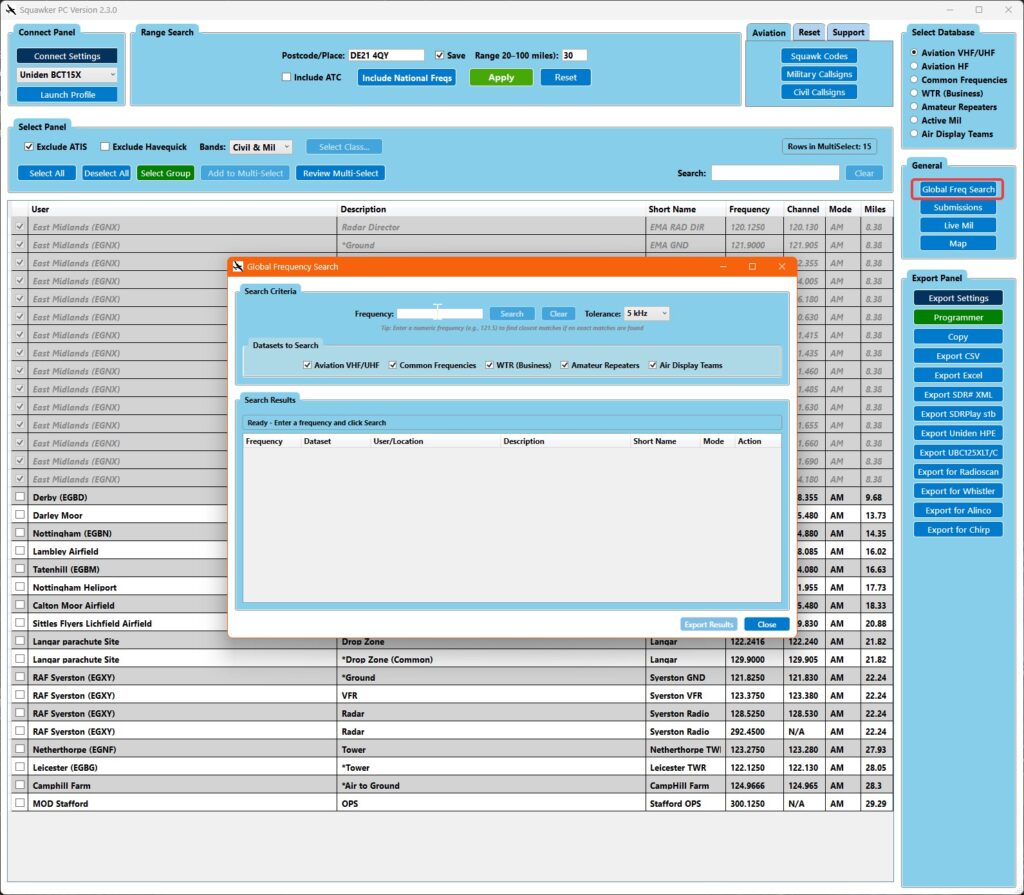
Global Freq Search answers one specific question: “which database (and where in it) does this frequency show up?” — without you having to switch datasets and search each one manually.
Setting Up a Search
Type a frequency, then choose which datasets to include — Aviation VHF/UHF, Common Frequencies, WTR (Business), Amateur Repeaters, and Air Display Teams are all ticked by default (Active Mil isn’t included, since it’s a live feed rather than a static dataset). Set a tolerance — from 5 kHz up to 25 kHz — to control how close a result needs to be to count as a match.
Reading Results
Results show Frequency, Dataset, User/Location, Description, Short Name, and Mode. Exact matches are shown normally; close matches within your chosen tolerance are shown distinctly (in italic/light blue) so you can tell an exact hit from a “nearest match.”
Jumping to a Result
Click Go to on any result to switch the main window straight to that dataset with the same search already applied — Global Search closes automatically once you do. This makes it a quick triage tool: search once across everything, then land exactly where you need to be to dig further or export.
Global Freq Search has its own Export Results button (CSV), separate from the main window’s export tools.