
How can we help?
Squawker Online
Squawker PC Manual
- The Main Window at a Glance
- Connect Panel - Managing Scanner/Radio Profiles
- Range Search - Filtering by Location
- The Aviation Tab - Quick Reference Lookups
- Select Database - Switching Between Datasets
- The Select Panel Toolbar - Filtering & Selecting Rows
- The Export Panel - Programmer & File Exports
- The General Panel - Reference Tools & Live Windows
- Programmer Screen at a Glance
- UBC125XLT/C Programmer - Overview & Getting Connected
- Filling a Bank — The Data Dropdown, Categories & the Overwrite Prompt
- Quick Fill - Auto-Populating Banks Near Your Location
- Editing, Sorting & Deleting Channels
- Reading, Backing Up & Restoring
- Writing to Your Scanner
- SDS100/SDS200/UBCD3600XLT Programmer Screen at a Glance
- SDS100/SDS200/UBCD3600XLT Programmer - Overview & Getting Connected
- Filling a Favorites List - The Data Dropdown, New Favorite & Add To
- Quick Fill - Auto-Populating a Full Set of Favorites Lists Near Your Location
- Editing, Sorting & Deleting - Favorites Lists, Systems, Departments & Channels
- Reading, Backing Up & Restoring
- Writing to Your Scanner - Mass Storage Mode
- BCT15X/UBC3500XLT/UBC800XLT Programmer Screen at a Glance
- BCT15X/UBC3500XLT/UBC800XLT Programmer - Overview & Getting Connected
- Model Differences - BCT15X, UBC3500XLT & UBC800XLT
- Filling Systems & Groups - Quick Fill, the Data Dropdown & Add To
- Editing, Sorting & Deleting Systems, Groups & Channels
- Reading, Backing Up & Restoring
- Writing to Your Scanner
- BCD160DN/BCD260DN Programmer Screen at a Glance
- BCD160DN/BCD260DN Programmer - Overview & Getting Connected
- Filling a Bank - The Data Dropdown & the Overwrite Prompt
- Quick Fill - Auto-Populating Banks Near Your Location
- Editing, Sorting & Deleting Channels
- Reading, Backing Up & Restoring
- Writing to Your Scanner
Interactive Map
WTRBrowser
Active Mil
UKAFG Printed Guide
Reading the Aircraft Info Panel
Summary: What’s shown when you click an aircraft, and how to interpret the predicted ATC frequency and weather data.
Click any aircraft on the map to open its info panel. Depending on the aircraft and available data, you’ll see:
- Identity — registration, aircraft type, and (for military aircraft) matched squadron or unit information where a callsign match is available.
- Position & motion — current altitude, selected/target altitude, ground speed, Mach number, indicated and true airspeed.
- Squawk — the transponder code, with its meaning decoded where known.
- Predicted ATC frequency — the map’s best guess at which frequency the aircraft is likely working, shown with a confidence badge. This is a prediction based on position and sector data, not a confirmed transmission.
- Current/next sector or airspace — which ATC sector or airspace block the aircraft is in or approaching.
- Destination frequency — likely frequency for the aircraft’s destination.
- Route — origin/destination where known; routes are flagged as “unverified” when the source data isn’t confirmed.
- Weather at departure/arrival — QNH, wind, and outside air temperature derived from the nearest METAR.
If you have an active Active Mil membership, predicted frequencies are additionally cross-checked against real transmissions heard on the live feed — see the Military Intelligence category for details.
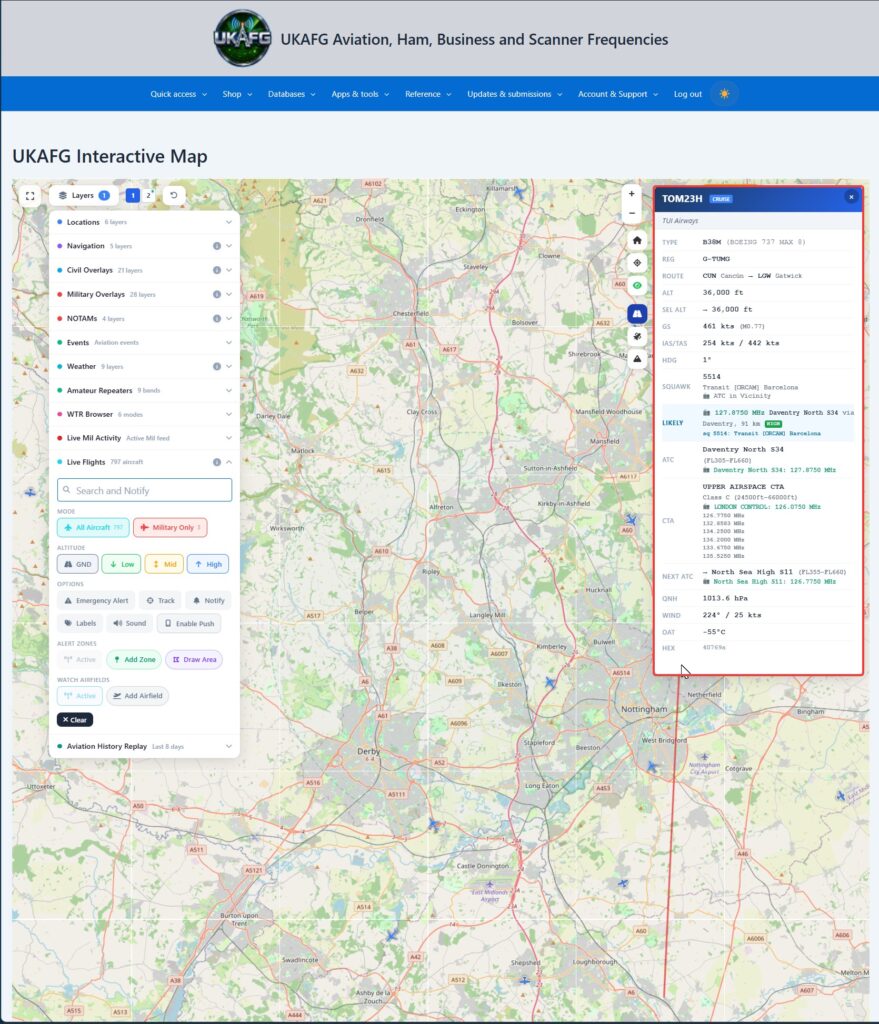
Table of Contents